In the high-stakes world of real estate, time isn’t just money it’s the difference between a signed contract and a lost opportunity. Yet, many firms are still handcuffed by "The Efficiency Tax": the hidden cost of using fragmented systems for CRM, property listings, and accounting. As the industry faces increasing pressure from digital-first competitors and volatile market conditions, the ability to operate with surgical efficiency is no longer a luxury; it is a survival requirement.
When your lead data lives in a spreadsheet, your lease agreements in a Word doc, and your financials in separate accounting software, your team spends more time bridging data gaps than closing deals. This is why forward-thinking agencies, developers, and property managers are migrating to Odoo for real estate.
By unifying the entire property lifecycle into a single source of truth, real estate firms are significantly reducing overhead, eliminating redundant data entry, and accelerating their "Time to Close" to record speeds.
The Efficiency Gap: Why Traditional Tools Are Failing
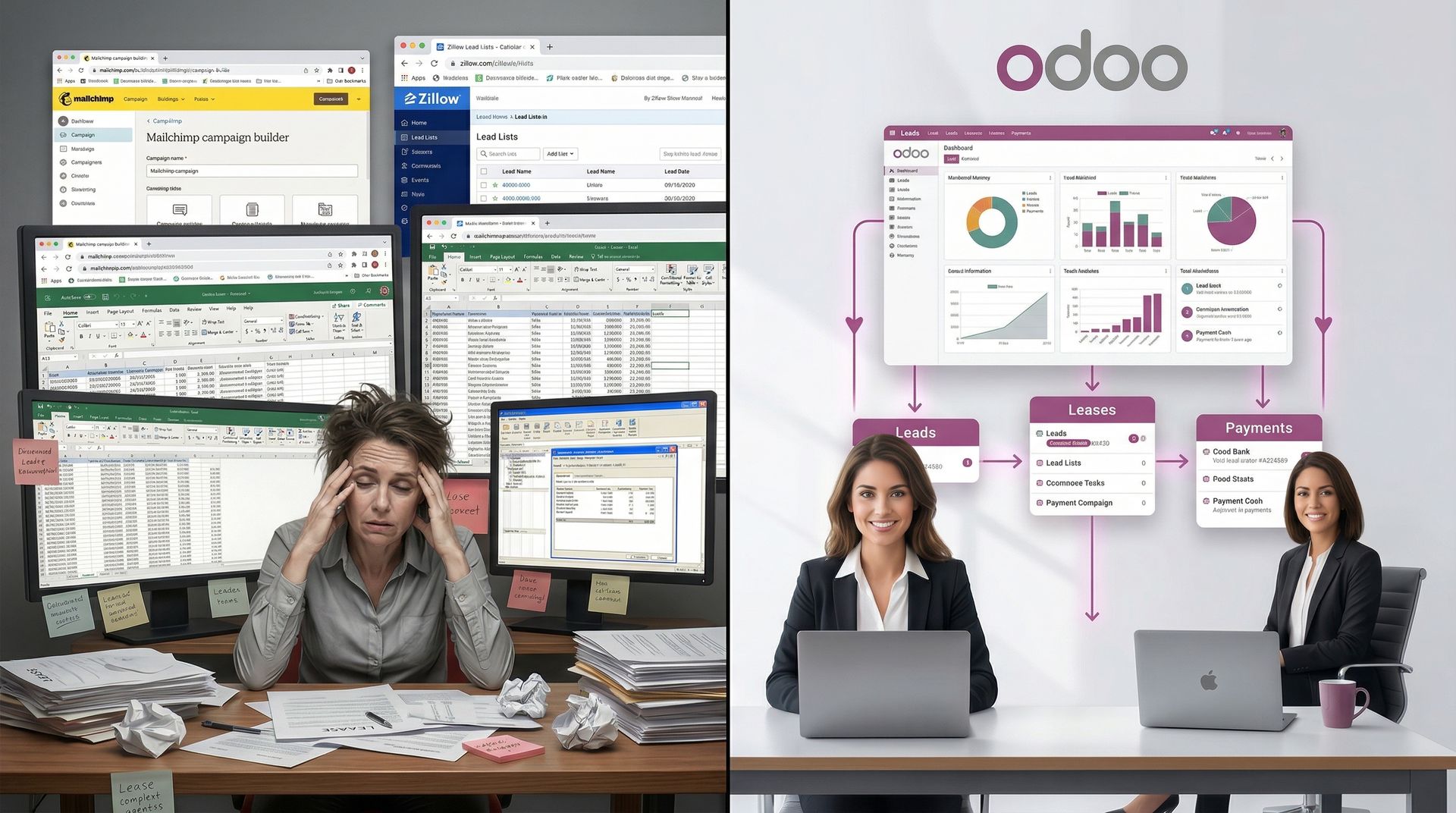
Most real estate operations suffer from what we call "Software Silos." In a typical mid-sized firm, the marketing team might use Mailchimp for newsletters, a separate "lite" CRM for leads, a standalone property management tool for maintenance, and QuickBooks or Xero for accounting.
While these tools are excellent in isolation, they are fundamentally disconnected. A marketing team captures a high-value lead on a portal like Zillow or Rewest, but that data must be manually exported and then imported into a CRM. Once a deal is struck, the administrative team must manually generate a lease by copying data from the CRM into a template. Finally, the finance team manually reconciles the security deposit when it hits the bank account.
This manual chain of custody is where errors thrive. Research suggests that administrative friction and manual data handling can delay property closings by up to 15%. Furthermore, every manual step introduces a 3% to 5% chance of data error. Odoo real estate management solves this by creating a continuous digital thread from the first click on a listing to the final digital signature on the deed.
1. Centralizing the Lead-to-Lease Pipeline with Odoo CRM
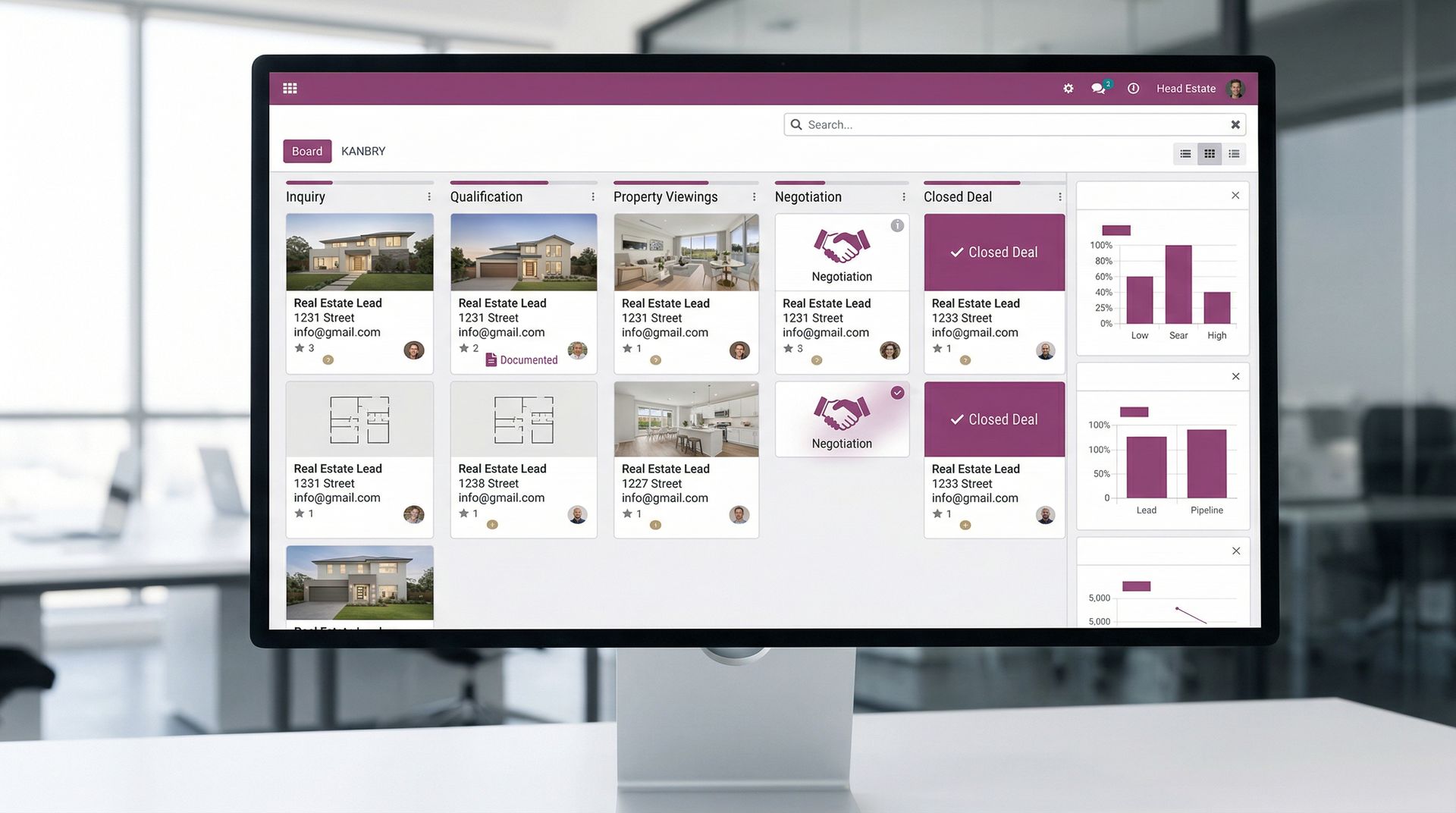
The fortune is in the follow-up, but in real estate, follow-ups often fall through the cracks because the "Lead-to-Lease" pipeline is leaky. Using Odoo for real estate allows firms to automate the "Front Office" with a level of precision that was previously only available to enterprise-level corporations.
Automated Lead Ingestion and Scoring
Odoo’s API connectors can be configured to pull leads directly from your website, social media ads, or external property portals. Unlike traditional CRMs, Odoo allows you to implement "Lead Scoring." For instance, a lead who has viewed a virtual tour three times and downloaded a floor plan is automatically ranked higher than a casual browser. This ensures your agents focus their energy on the "hottest" prospects.
Activity-Based Triggering
If a lead interacts with a specific property listing, Odoo can automatically trigger a scheduled call or a personalized email for the agent. This "Speed to Lead" is critical; studies show that responding to a lead within five minutes increases the likelihood of conversion by nearly 100x compared to a 30-minute delay.
360-Degree Communication
In many firms, if an agent goes on leave, the lead goes cold because the history of their conversation is buried in a private inbox. In Odoo, every email, call log, and WhatsApp message is stored under the lead profile. This eliminates the "Who spoke to this client last?" confusion and allows any team member to pick up the conversation exactly where it left off, providing a seamless experience for the client.
2. Cutting Overheads with Odoo Property Management
Once a property is under management whether it’s a residential unit, a commercial office, or a retail space the "Operational Heavy Lifting" begins. Odoo property management modules transform a reactive, fire-fighting business model into a proactive, data-driven operation.
Automated Maintenance and the ROI Factor
Maintenance is often a black hole for expenses. Odoo allows tenants to submit repair requests via a dedicated mobile-responsive portal. This request doesn't just sit in an inbox; it automatically creates a work order, notifies the preferred vendor, and asks for a quote.
Crucially, these costs are tracked against that specific unit’s ROI. If Unit 4B is consistently requiring more maintenance than others, Odoo’s reporting will flag it. By automating the dispatch and tracking process, firms can reduce administrative labor by 25% or more while extending the life of their physical assets through predictive maintenance.
Smart Accounting and Rent Collection
Chasing rent is perhaps the least productive use of a high-value employee's time. Odoo’s accounting engine handles the heavy lifting by automating recurring invoices and sending automated, polite reminders for overdue payments.
Because the accounting module is natively integrated with the leasing module, your "Profit and Loss" statement updates in real-time. When a tenant pays via the online portal (supporting Stripe, PayPal, or bank transfer), Odoo performs "Automatic Reconciliation." It identifies the invoice, marks it as paid, and updates the owner’s statement without a single human keystroke.
3. Closing Deals Faster: Digital Signatures and Instant Contracts

The "Closing" phase is the most fragile part of a real estate deal. This is the moment where "Buyer’s Remorse" or "Tenant Cold Feet" sets in. The longer it takes to move from a verbal "Yes" to a signed contract, the higher the risk of the deal collapsing.
With Odoo Sign integration, agents no longer need to wait until they are back at their desks to prepare paperwork. They can generate a lease or sales agreement from a pre-approved template directly from their tablet or smartphone while still at the property.
The system pulls the buyer's data and property details directly from the CRM, eliminating the risk of typos in critical legal descriptions. The document is sent for an e-signature immediately. Once signed, the system:
- Automatically archives the document in the Odoo Documents app.
- Triggers the initial deposit invoice.
- Moves the property status from "Available" to "Under Contract" across all integrated platforms. What used to take 48 hours of back-and-forth now takes 48 seconds.
4. Advanced Analytics: From Intuition to Data-Driven Decisions
In the past, real estate leaders made decisions based on "gut feeling" or delayed monthly reports. Odoo provides real-time dashboards that offer a "God’s Eye View" of the entire portfolio.
- Occupancy Rates: View real-time vacancy maps to identify which regions or building types are underperforming.
- Yield Analysis: Automatically calculate the Net Operating Income (NOI) and Capitalization Rate (Cap Rate) for every asset in the portfolio.
- Agent Performance: Track conversion rates from lead-to-close per agent to identify training needs or reward top performers.
With Odoo’s integrated spreadsheet tool, you can build complex financial models that live-link to your ERP data. If a tenant moves out, your projected revenue for the quarter updates automatically.
5. Key Features for Real Estate Developers
For firms involved in the construction and development phase, Odoo for real estate extends its utility into the "Project" and "Purchase" modules:
- Budget vs. Actuals: Real estate development is notorious for budget overruns. Odoo allows developers to track every dollar spent on materials and labor against the original project budget.
- Vendor Management: Handle complex sub-contractor payments, track insurance certifications, and manage tax compliance (like 1099s) within a single ecosystem.
- Inventory and Pre-sales: Manage "un-built" inventory (units still under construction) and track pre-sales progress through custom Kanban stages, ensuring that cash flow remains healthy throughout the build cycle.
6. Scalability and Global Operations
As your firm grows, Odoo grows with you. If you expand into international markets, Odoo’s multi-company and multi-currency features ensure that you can manage a property in London, a developer in Dubai, and an HQ in New York within the same database. The system handles currency fluctuations and local tax localizations automatically, providing a consolidated financial view of the global enterprise.
Implementation Strategy: How to Transition to Odoo
Transitioning from a legacy system to an ERP can feel daunting. At ERP Consulting Group, we follow a proven three-phase approach to ensure a smooth migration:
- Discovery & Mapping: We analyze your current "Lead-to-Lease" workflow and map it to Odoo’s modular structure, identifying opportunities for automation.
- Data Migration: We securely migrate your historical lead, tenant, and financial data into Odoo, ensuring data integrity is maintained.
- Training & Optimization: We provide hands-on training for agents and admin staff, ensuring that the team isn't just using the software, but is using it to close deals faster.
Conclusion: The Competitive Edge of Integration
In 2024 and beyond, the real estate firms that thrive won't just be those with the best locations they will be the ones with the best data. By implementing Odoo for real estate, you are removing the administrative friction that slows your growth.
You aren't just buying an ERP; you are buying back the hours your team currently spends on manual data entry. You are investing in a system that allows your agents to do what they do best: build relationships and close the next big deal.
Ready to Modernize Your Real Estate Operations?
Stop letting your growth be stunted by fragmented technology.
At ERPConsulting24, we specialize in tailoring Odoo to the unique, high-pressure demands of the real estate sector.

 Recent Posts


 Free Consultation