Choosing the right Enterprise Resource Planning (ERP) system is a pivotal decision that can significantly impact your business's efficiency, growth, and bottom line. As we look towards 2026, the ERP landscape continues to evolve, with Zoho and Odoo standing out as two prominent contenders. Both offer comprehensive suites of business management tools, but they cater to different needs and philosophies. For businesses exploring their options on erpconsulting24.com, understanding the nuances between Zoho and Odoo is crucial.
Understanding the Core Philosophies
Before diving into features, it's helpful to grasp the fundamental approaches of each platform.
| Feature Category | Zoho (Zoho One) | Odoo (Enterprise) |
| Core Architecture | Integrated Suite of 45+ Apps | Single Modular ERP Database |
| Best For | Sales, Marketing, & Service-based SMEs | Manufacturing, Logistics, & Complex Trading |
| Customization | Moderate (Low-code/UI-driven) | Extremely High (Open-source/Python) |
| Deployment | Cloud-only | Cloud, On-Premise, or Hybrid |
| Learning Curve | Gentle; intuitive for non-tech users | Steeper; requires initial training/setup |
| Implementation | Fast (Days to 2 weeks) | Gradual (Weeks to Months) |
| Pricing Model | Predictable per-user subscription | Flexible; pay for users + specific apps |
| Manufacturing/MRP | Limited (Basic assembly) | Robust (Full MRP, Work Centers, BOM) |
| Accounting | Strong SME focus (Zoho Books) | Advanced (Multi-company, GST/Landed Cost) |
| Scalability | Standard business growth | Complex, multi-departmental scaling |
| AI Integration | Zia AI (Predictive sales & support) | Odoo Copilot (Contextual automation) |
Zoho ERP (often represented by Zoho One): The Integrated Ecosystem
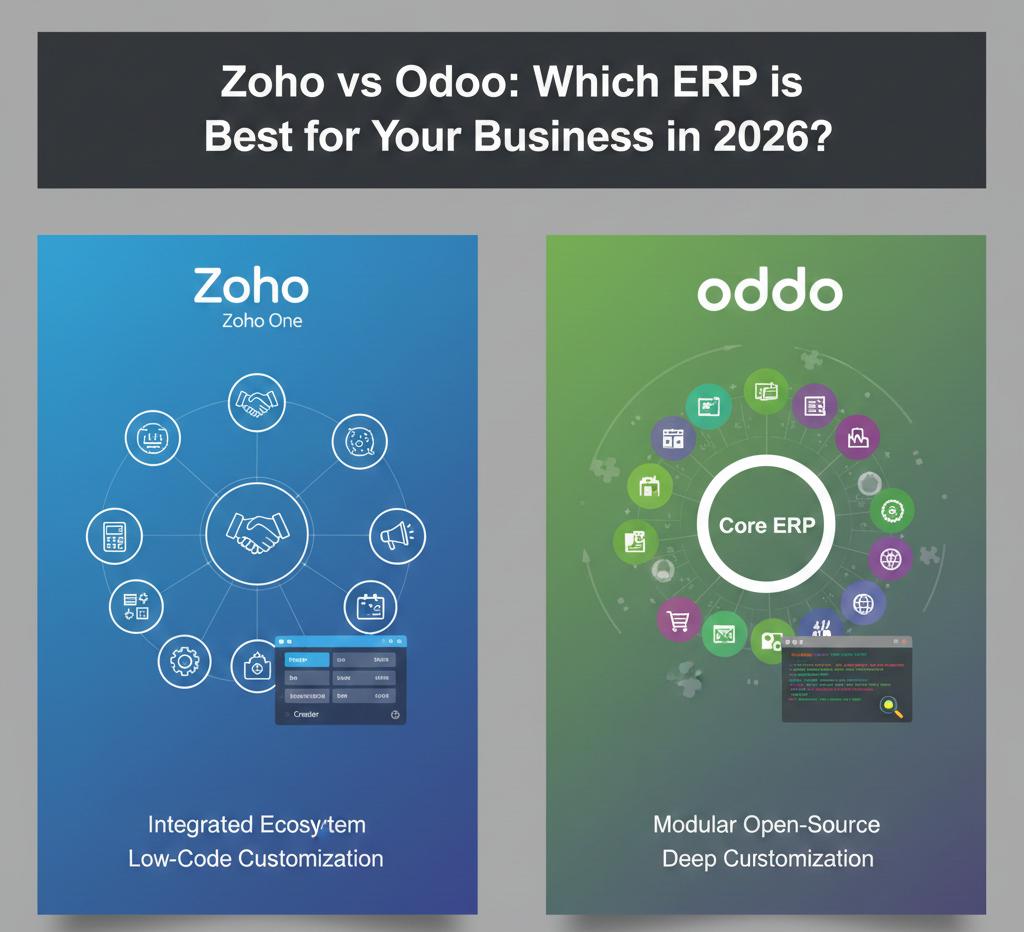
Zoho operates on an "ecosystem" principle. Rather than a single monolithic ERP, Zoho One is a suite of over 45 interconnected applications that cover virtually every aspect of a business – from CRM and finance to HR, marketing, and project management. The strength of Zoho lies in its seamless integration and consistent user experience across its vast array of tools. It's designed to be an all-in-one solution that eliminates the need for disparate software from different vendors.
Odoo: The Modular Open-Source Powerhouse
Odoo, on the other hand, is an open-source ERP system known for its modularity and flexibility. It offers a core set of robust business applications (CRM, Sales, Accounting, Inventory, Manufacturing, etc.), which can then be extended with thousands of community-developed or custom modules. This open-source nature means a high degree of customization and control, appealing to businesses with very specific or complex requirements.
Key Feature Comparison: Where They Shine
Let's break down some critical areas to see how Zoho and Odoo stack up.
1. Scalability and Flexibility
Zoho: Highly scalable, especially for small to medium-sized businesses (SMBs) looking for a unified platform. Its extensive app library means you can add functionalities as you grow without significant integration headaches.
Odoo: Exceptionally flexible due to its modular architecture. Businesses can start with essential modules and add more as needed. Its open-source nature allows for deep customization, making it suitable for businesses with unique workflows or industry-specific needs, including larger enterprises.
2. Customization and Development
Zoho: Offers robust customization options within its applications (custom fields, workflows, reports, etc.). For more advanced integrations or bespoke features, Zoho Creator allows for low-code development of custom applications that seamlessly integrate with the rest of the Zoho suite.
Odoo: This is where Odoo truly shines for those needing deep customization. Its open-source code allows developers to modify existing modules or build entirely new ones from scratch. This level of control is invaluable for businesses with highly specialized processes that off-the-shelf solutions can't accommodate.
3. User Interface and Ease of Use
Zoho: Generally praised for its clean, intuitive, and consistent user interface across its applications. The learning curve for individual Zoho apps is relatively gentle, though mastering the entire Zoho One suite takes time due to its sheer breadth.
Odoo: Offers a modern and user-friendly interface. While individual modules are generally easy to navigate, the sheer number of modules and the potential for customization can make the initial setup and configuration more complex than Zoho for non-technical users.
4. Pricing Model
Zoho: Primarily offered through a subscription-based model, with Zoho One providing exceptional value by bundling all applications for a single per-user fee. This predictable pricing makes budgeting easier.
Odoo: Has a more nuanced pricing structure. The Community Edition is free but requires self-hosting and lacks some features. The Enterprise Edition is subscription-based, with pricing dependent on the number of apps, users, and hosting options (Odoo Cloud vs. on-premise). Custom development and third-party modules also add to the cost.
5. Community and Support
Zoho: Provides comprehensive official support, including documentation, webinars, and direct customer service. The user community is also active, though not as developer-centric as Odoo's.
Odoo: Boasts a massive and vibrant open-source community. This means extensive forums, documentation, and a wealth of third-party developers and partners offering support and custom solutions. Official support is available with the Enterprise Edition.
Use Cases: Who Benefits Most?
Choose Zoho if:
- You're an SMB looking for an all-in-one solution. Zoho One offers an incredible bang for your buck, consolidating all your business software into a single, integrated platform.
- You value seamless integration and a consistent user experience. The tight integration between Zoho's apps eliminates data silos and improves workflow efficiency.
- You prefer a predictable, subscription-based pricing model.
- You need robust functionality across many business areas without requiring extensive, deep-level code customization.
- You want to minimize vendor sprawl and manage all your software through one provider.
Choose Odoo if:
- You require deep customization and flexibility to match unique business processes. Its modular and open-source nature makes it ideal for highly specialized industries or complex workflows.
- You have in-house technical expertise or a dedicated ERP implementation partner. Leveraging Odoo's full potential often involves development.
- You are a growing enterprise that anticipates significant changes or highly specific requirements in the future.
- You prefer the open-source philosophy and want control over your software's codebase.
- Cost optimization for core functionalities is key, and you're willing to manage self-hosting (Community Edition).
Also Read: Odoo vs. SAP: A Comprehensive ERP Software Comparison
The Future in 2026: What to Expect
Both Zoho and Odoo are continually investing in innovation.
Zoho will likely continue to expand its AI capabilities, enhance cross-app intelligence, and further refine its user experience, solidifying its position as a comprehensive business operating system.
Odoo will probably see further development in its core modules, increased adoption of cloud offerings, and an even richer ecosystem of community and enterprise modules, making it even more adaptable to niche markets.
The "best" ERP isn't a universal answer; it's the one that aligns perfectly with your business's current needs and future aspirations.
- Assess Your Requirements: Document your core business processes, pain points, and must-have features. Consider your budget, technical resources, and growth projections.
- Evaluate Integration Needs: How critical is it for your various business functions to be seamlessly connected?
- Consider Customization vs. Out-of-the-Box: Do you need an off-the-shelf solution that can be configured, or do you have unique processes that require deep customization?
- Test Drive: Both platforms offer demos or trials. Take advantage of them to get a feel for the user experience and functionality.
Conclusion
Choosing between Zoho and Odoo in 2026 depends on your business size, industry, and future growth plans. Zoho is a great option for startups and service-based companies looking for a quick, cloud-first system with simple workflows. On the other hand, Odoo is the better ERP for businesses that need flexibility, deep customization, advanced inventory, or manufacturing (MRP) capabilities.
If your company wants an ERP that can scale with complex processes, multi-location operations, and automation, Odoo is the stronger long-term solution. But if you prefer ready-to-use apps with minimal setup and a smooth user experience, Zoho can be a practical choice.
FAQ
1. Which platform supports website + eCommerce better?
Odoo provides a built-in website + eCommerce + POS, fully integrated with inventory and accounting. Zoho usually requires external integrations for websites and e-commerce.
2. Which ERP is better for manufacturing businesses?
Odoo is the best choice for manufacturing because it supports MRP, BOM, work orders, quality checks, and production planning.
3. Is Zoho cheaper than Odoo?
Zoho is often cheaper at the start, but costs increase when you add multiple apps. Odoo can offer better long-term value.
4. Can Zoho be used as a complete ERP?
Yes, Zoho can work as an ERP by combining apps like Books, Inventory, CRM, and People, but it suits businesses with basic requirements.
5. Can Odoo be customized more than Zoho?
Yes. Odoo offers deeper customization with custom modules and workflows, whereas Zoho customization is limited compared to Odoo.
 Recent Posts
 Free Consultation