For most business owners, accounting is the least exciting part of the job. It’s often viewed as a necessary evil. A mountain of paperwork, spreadsheets that refuse to balance, and the looming anxiety of tax season. Traditionally, financial management has been a siloed, manual process that eats up valuable time that could be spent growing the business.
But what if your accounting software actually worked for you, rather than just being a digital filing cabinet?
This is where Odoo Accounting enters the picture. Odoo isn't just another standalone bookkeeping app; it is a fully integrated financial hub that connects directly with your sales, inventory, purchases, and operations. It’s designed to automate the mundane, provide crystal-clear visibility into your financial health, and turn your accounting department from a cost center into a strategic asset.
In this guide, we will explore why businesses are making the switch to Odoo and dive deep into the top features that make financial transactions smoother than ever before.
Benefits of Odoo Accounting Software
Why should a business consider moving off legacy systems or disconnected spreadsheets onto Odoo? The primary driver is integration. When your accounting system talks directly to your sales and inventory systems, magic happens.
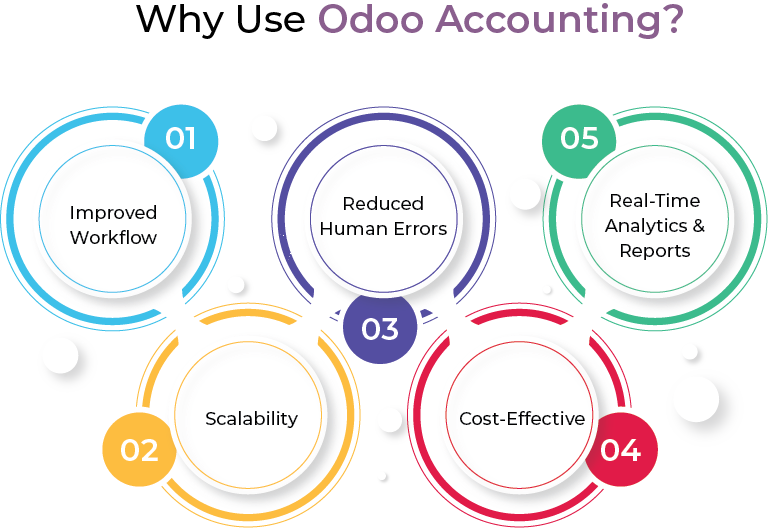
Here are the five key benefits businesses realize when adopting Odoo Accounting:
1. Improved Workflow through Automation
The biggest drain on financial productivity is data re-entry. A salesperson closes a deal in one system, and an accountant has to manually re-type that data to create an invoice in another. Odoo eliminates this entirely.
Because Odoo is modular and integrated, an approved sales order automatically generates a draft invoice in accounting. A received inventory shipment automatically tells accounting that a vendor bill is due. This seamless flow means less time typing and more time analyzing.
2. Reduced Mistakes
We are only human, and manual data entry is rife with opportunities for error. A misplaced decimal point or a forgotten transaction can lead to hours of agonizing reconciliation at month-end. By automating the creation of journal entries from other business operations, Odoo significantly reduces the "human element" in routine bookkeeping.
Furthermore, features like automated bank synchronization mean your records always match what’s actually in the bank, catching discrepancies immediately rather than weeks later.
3. Real-Time Analytics and Reports
In many businesses, financial reports are a look into the past, sometimes waiting until the 15th of the next month to see how you did. You cannot make agile business decisions by looking in the rearview mirror.
Odoo provides real-time visibility. Because every transaction is recorded instantly, your Profit & Loss statement, Balance Sheet, and Cash Flow reports are accurate right now. You get customizable dashboards that give you a snapshot of your financial health the moment you log in.
4. Scalability
Many accounting solutions are great for startups, but crumble under the weight of growth. Odoo scales effortlessly. Furthermore, if your business has unique financial workflows such as specific commission structures or niche billing cycles , Odoo customization allows you to tailor the system to your exact requirements without breaking the core functionality.
5. Cost-Effective
Compared to sprawling enterprise ERP systems like SAP or Oracle, Odoo offers incredible functionality at a fraction of the cost. Its open-source roots and modular pricing structure mean you only pay for the features you need, making enterprise-grade accounting accessible to Small and Medium-sized Businesses (SMBs).
Top 12 Odoo Accounting Features for Smooth Financial Transactions
Odoo is packed with features, but some are true game-changers for daily financial operations. Here are the top 12 features designed to streamline your books.
1. Smart Bank Reconciliation This is perhaps the most loved feature in Odoo. You can synchronize your bank accounts directly with Odoo. The system imports your bank statements automatically and uses smart algorithms to match transactions to your existing invoices or payments. Often, you just need to click "Validate," and hours of tedious reconciliation are finished in minutes.
2. Intuitive Invoicing and Online Payments Creating professional-looking invoices takes seconds. You can send them directly via email, and Odoo includes a "Pay Now" button on the electronic invoice. This allows customers to pay instantly using credit cards, PayPal, or other payment gateways, significantly speeding up your accounts receivable cycle.
3. Automated Follow-ups Chasing late payments is uncomfortable and time-consuming. Odoo automates accounts receivable management. You can set up predefined "follow-up levels" (e.g., a polite email at 3 days overdue, a firmer letter at 15 days). Odoo handles the chasing automatically, ensuring nothing slips through the cracks.
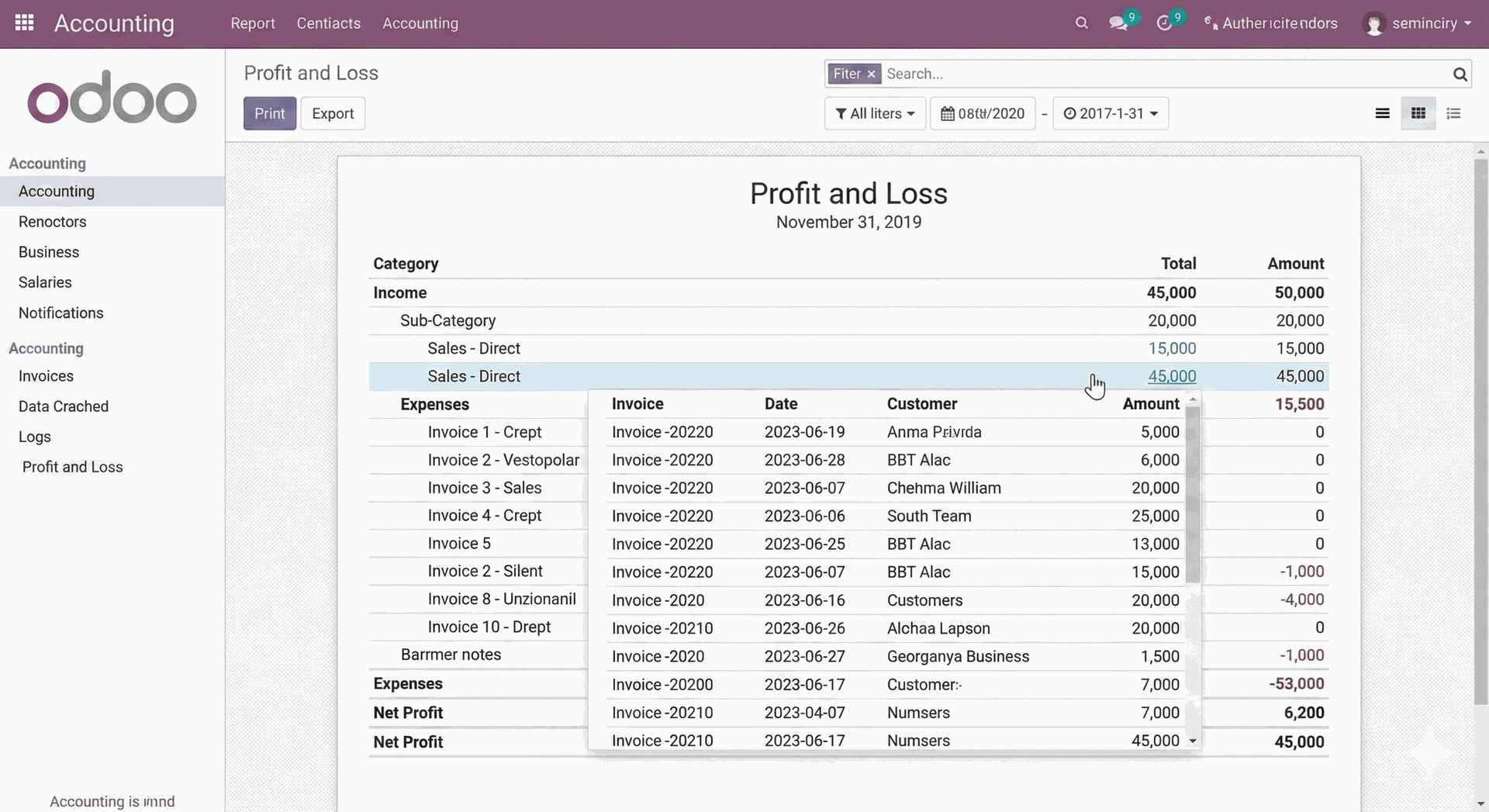
4. Dynamic Reporting with Drill-Down Odoo’s reports aren't static PDFs. If you are looking at a Profit & Loss statement and see a suspicious number under "Office Expenses," you can click on that number. It will drill down into the general ledger entries that make up that total, right down to the original vendor bill.
5. Multi-Currency Support For businesses operating globally, handling exchange rates is a headache. Odoo manages multi-currency transactions effortlessly. It automatically updates exchange rates daily and handles the resulting exchange rate gains or losses automatically in your journal entries.
6. AI-Powered Bill Digitization (OCR) Stop typing out vendor bills manually. With Odoo’s Optical Character Recognition (OCR) and Artificial Intelligence, you can simply scan a PDF or image of a vendor bill. Odoo reads the document, identifies the vendor, the dates, and the amounts, and automatically creates the draft bill for you to review.
7. Analytic (Cost) Accounting General accounting tells you what you spent money on (e.g., Salaries). Analytic accounting tells you why or where you spent it. You can track costs and revenues by project, department, or product line, giving you a clear picture of profitability across different areas of your business.
8. Comprehensive Asset Management Managing fixed assets and their depreciation schedules used to require separate spreadsheets. Odoo allows you to track assets directly in the system, set up automatic depreciation boards (linear, degressive, etc.), and generate the necessary journal entries automatically each period.
9. Easy Expense Management Employees can snap photos of receipts on their mobile phones and submit expense reports directly into Odoo. Managers approve them with a click, and the accounting department can reimburse them in the next payment run, all seamlessly integrated.
10. Localized Tax Compliance Odoo supports fiscal localization for dozens of countries right out of the box. This means the system comes pre-configured with the correct chart of accounts, tax rates, and legal reporting requirements for your specific region, ensuring compliance is maintained automatically.
11. Efficient Check Writing and Printing For businesses that still rely on checks, Odoo simplifies the process. You can select multiple vendor bills to pay, and Odoo will generate the check payments, allowing you to print checks directly from the system in batch.
12. Budget Management Planning for the future is crucial. Odoo allows you to define budgets for specific periods and analytic accounts. You can then track your "Planned vs. Actuals" in real-time, seeing immediately if a department is about to overspend.
Conclusion
Modern business moves too fast for outdated accounting methods. If your finance team is spending more time entering data than analyzing it, it’s time for a change.
Odoo Accounting is more than just a ledger; it is a comprehensive tool for financial control. By automating routine tasks and integrating seamlessly with operations, Odoo empowers business owners to make smarter decisions faster.
However, migrating financial data is a sensitive task. To ensure a smooth transition and correct data migration, many companies choose to utilize professional Odoo implementation services. With the right support and a powerful tool like Odoo, you can turn your accounting function into a well-oiled machine that drives business growth.
 Recent Posts



 Free Consultation